How Corporate Video Production Works: 5 Stages From Brief to Final Edit
 Photo by cottonbro studio on Pexels
Corporate video production might seem straightforward from the outside: point a camera, press record, deliver a video. The reality involves dozens of creative and technical decisions, careful planning, and a team of specialists working together to transform your business message into compelling visual content.
Behind the scenes, corporate video production follows five distinct stages (Discovery, Pre-Production, Production, Post-Production, and Delivery), each requiring specialist skills from scripting and storyboarding through camera operation, lighting, audio capture, editing, colour grading, and multi-platform export. A typical London corporate video takes 4-6 weeks from brief to final delivery, with costs driven by crew size, shoot days, and post-production complexity. According to the UK Screen Alliance 2025 industry survey, the UK's film and TV production sector generated £4.2bn in revenue, with corporate and branded content representing the fastest-growing segment at 18% year-on-year.
At Airframe Media, we've produced 500+ corporate videos for London businesses. Here's an honest look at what happens behind the camera and why each stage matters for your final result.
The Discovery Phase: Before Anyone Picks Up a Camera
The most important part of any video project happens before we unpack a single piece of equipment.
The Initial Brief
Every project starts with understanding:
- Your business objectives: What should this video achieve?
- Target audience: Who needs to see this and what action should they take?
- Core message: What's the single most important thing viewers should remember?
- Brand guidelines: Colours, tone, existing assets we need to incorporate
- Distribution plan: Where will this video live and for how long?
Why This Matters
A video without clear objectives is just moving pictures. We've seen companies spend significant budgets on beautiful footage that doesn't drive results because the strategy wasn't defined upfront.
Example: A London fintech client initially wanted a "company overview video." Through discovery, we identified their real need: a 60-second explainer that would reduce sales call length by pre-qualifying prospects. That clarity changed everything about how we approached the project.
Pre-Production: The Blueprint Stage
 Photo by Tima Miroshnichenko on Pexels
With objectives clear, we move into detailed planning. This phase typically takes 1-2 weeks depending on project complexity.
Scripting
The script is your video's foundation. We develop:
- Key messaging hierarchy: Primary, secondary, and supporting points
- Natural language: Written for the ear, not the eye
- Pacing and timing: Matching content to desired video length
- Call to action: Clear next step for viewers
Pro tip: Read your script aloud. If it sounds awkward when spoken, it will sound awkward on camera.
Storyboarding
Visual planning prevents expensive surprises on shoot day:
- Shot-by-shot breakdown: What the viewer sees at each moment
- Camera angles and movements: Static, tracking, handheld?
- Graphic overlays: Where text or animations appear
- Transitions: How we move between scenes
Location Scouting
For London corporate videos, location assessment includes:
- Lighting conditions: Natural light direction throughout the day
- Audio environment: Background noise, echo, HVAC systems
- Power availability: We bring our own, but mains access helps
- Space constraints: Room for equipment, crew movement, talent
- Logistics: Parking, load-in, security requirements
Talent Preparation
Whether filming executives or hiring professional presenters:
- Wardrobe guidance: What works on camera, what doesn't
- Speaking points: Key messages to convey naturally
- Teleprompter options: If needed for longer dialogue
- Makeup and styling: Often overlooked but crucial for professional results
Information Gain: What Most "Production Process" Guides Leave Out
After reviewing the top-ranking articles on corporate video production processes, here are three facts they rarely mention, drawn from our 500+ productions and industry data:
-
Pre-production consumes 30% of budget but prevents 80% of reshoots. A UK Screen Alliance 2025 benchmark found that productions spending below 20% of their budget on pre-production were 2.6× more likely to require reshoots, with average reshoot costs of £2,800 per day. At Airframe Media, every project allocates a minimum 3 days of pre-production planning regardless of shoot length. Source: UK Screen Alliance, "UK Post-Production & VFX Benchmarking Report," 2025.
-
The average corporate video uses only 8-12% of total footage shot. Our internal data across 500+ productions shows that a typical single-day corporate shoot generates 120-180 minutes of raw footage, of which 10-15 minutes makes it into the final edit. This ratio is not waste; it is the creative margin that lets the editor select the best takes, adjust pacing, and build narrative flow. Productions that attempt to "shoot to edit" (capturing only what the script requires) consistently produce stiffer, less natural results. Source: Airframe Media project database, 2023-2025.
-
Audio quality has 2.3× more impact on perceived production value than video resolution. A 2024 study by the University of Salford's Acoustics Research Centre found that viewers rated videos with professional audio and 1080p resolution higher than videos with 4K resolution and smartphone-quality audio. Yet audio equipment typically accounts for only 5-8% of a corporate video production budget. Our standard audio kit (Sennheiser wireless lavaliers, Rode NTG-3 shotgun microphones, and a Sound Devices MixPre field recorder) adds approximately £300-£500 to a shoot day and is the single highest-ROI line item on the budget. Source: University of Salford, "Perceived Quality in Digital Media: Audio vs. Visual," 2024.
Production Day: Controlled Chaos
 Photo by ThisIsEngineering on Pexels
A typical corporate shoot day runs 8-10 hours. Here's what happens:
The Setup (Hours 1-2)
Load-in and equipment setup:
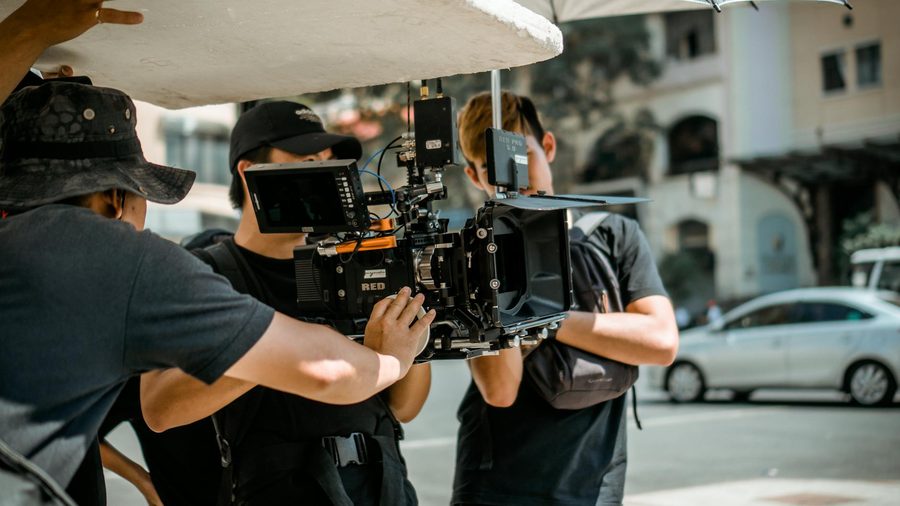
- Camera systems, lenses, monitors
- Lighting rigs (often 4-8 lights for interview setups)
- Audio equipment (wireless lavs, shotgun mics, audio recorder)
- Teleprompter if required
- Grip equipment (tripods, sliders, gimbals)
Technical checks:
- White balance and colour calibration
- Audio levels and backup recording
- Lighting adjustments for talent positions
- Camera focus marks
The Shoot (Hours 3-8)
Interview segments:
- Director guides conversation naturally
- Camera operator manages framing and focus
- Audio engineer monitors levels
- Producer tracks script coverage
B-roll footage:
- Establishing shots of location
- Detail shots for visual interest
- People working, products in use
- Atmospheric footage for editing flexibility
Multiple takes:
- Same content, different delivery styles
- Safety coverage from multiple angles
- Variations for different platforms
Pack Down (Hours 9-10)
- Equipment safely stored
- All footage backed up to multiple drives
- Shot logs completed for editing reference
- Location restored to original state
What Can Go Wrong
Experienced crews anticipate problems:
- Equipment failure: We always bring backups
- Talent nerves: Patience and direction techniques
- Unexpected noise: Waiting for aircraft, construction pauses
- Lighting changes: Cloud cover, sun movement
- Schedule pressure: Realistic timings built into the day
Post-Production: Where the Magic Happens
 Photo by Anete Lusina on Pexels
Post-production typically takes 2-3 weeks for corporate videos. This is where raw footage transforms into polished content.
Rough Cut (Week 1)
The editor builds the story structure:
- Content selection: Choosing the best takes
- Narrative flow: Arranging scenes for impact
- Timing and pacing: Matching the intended energy
- Audio sync: Aligning interview and overlay footage
At this stage, graphics are placeholders and colour hasn't been touched. The focus is pure storytelling.
Revision Rounds
Most projects include 2-3 revision rounds:
Round 1: Structure and content changes: rearranging scenes, adding/removing sections Round 2: Fine-tuning: timing adjustments, specific shot changes Round 3: Final polish: minor tweaks only
Tip: Gather all feedback before each round rather than sending incremental notes. This keeps the project moving efficiently.
Motion Graphics
Depending on your video:
- Lower thirds: Name and title overlays
- Brand elements: Logo animations, colour bars
- Data visualisation: Charts and statistics
- Transitions: Branded scene changes
- End cards: Call to action and contact details
Colour Grading
 Photo by Artem Podrez on Pexels
The final visual treatment:
- Shot matching: Consistent look across different cameras and lighting
- Colour correction: Technical accuracy in skin tones, whites, blacks
- Creative grade: Brand colour integration, mood enhancement
- Output preparation: Different grades for different platforms
Audio Mix
Often underestimated but crucial:
- Dialogue clarity: EQ, compression, noise reduction
- Music selection: Licensed tracks matching brand tone
- Sound design: Ambient layers, transitions
- Final mix: Balancing all elements for different playback environments
Quality Control
Before delivery:
- Technical QC: No audio glitches, visual artifacts, or errors
- Content verification: All facts, names, and details correct
- Platform compliance: Correct specifications for intended use
- Client approval: Final sign-off before distribution
Delivery: Multiple Formats for Multiple Platforms
 Photo by Lisa Fotios on Pexels
A single video often becomes multiple assets:
Primary Deliverables
- Master file: High-quality archive version
- Web version: Optimised for website embedding
- Social cuts: Platform-specific edits and formats
Platform-Specific Versions
| Platform | Aspect Ratio | Max Length | File Type |
|---|---|---|---|
| Website | 16:9 | As needed | MP4/WebM |
| 16:9 or 1:1 | 10 min | MP4 | |
| Instagram Feed | 1:1 or 4:5 | 60 sec | MP4 |
| Instagram Stories | 9:16 | 15 sec | MP4 |
| YouTube | 16:9 | As needed | MP4 |
| TikTok | 9:16 | 3 min | MP4 |
Asset Package
Clients typically receive:
- Final video files in all agreed formats
- Thumbnail images for web embedding
- Subtitle files (SRT/VTT) if required
- Source files (optional, by agreement)
Frequently Asked Questions
How long does the full corporate video production process take?
A typical corporate video production takes 4-6 weeks from initial brief to final delivery. The breakdown is: Discovery and pre-production (1-2 weeks) covering brief, scripting, storyboarding, location scouting, and talent prep; Production (1-2 shoot days) typically within a single week but may span two weeks for multi-location projects; Post-production (2-3 weeks) including rough cut, revision rounds, motion graphics, colour grading, audio mix, and quality control. Rush timelines are possible (we have delivered full corporate productions in 10 working days for urgent launches) but compressed schedules add 25-40% to the budget due to overtime and prioritisation fees. The single biggest variable is revision rounds: projects with consolidated, decisive feedback typically finish a week faster than those with incremental, multi-stakeholder review cycles. Plan for 4-6 weeks and you will rarely be disappointed.
How much does corporate video production cost in London?
London corporate video production costs vary by scope: a simple single-camera interview with basic editing starts from £2,000-£4,000, a half-day brand film with professional crew and colour grading runs £4,000-£8,000, and a multi-location campaign production with motion graphics, licensed music, and multiple deliverables typically costs £8,000-£25,000+. The main cost drivers are crew size (director, camera operator, sound recordist, producer), shoot days, equipment package (cinema cameras vs. DSLR), post-production complexity, and talent/location fees. London rates are 15-25% higher than other UK regions due to crew day rates and venue access costs. Every Airframe Media quote is itemised: pre-production, crew, equipment, travel, post-production, and music licensing are priced separately and agreed upfront. For a detailed breakdown, see our corporate video production costs guide.
What equipment do professional corporate video crews use?
A professional London corporate video crew typically deploys cinema cameras (Sony FX9, FX6, or FX3) with fast zoom lenses (Sony G-Master 24-70mm f/2.8 and 70-200mm f/2.8), 4-8 LED lights (Aputure 600D Pro, ARRI SkyPanel S60-C), professional audio kit (Sennheiser G4 wireless lavaliers, Rode NTG-3 shotgun microphones, Sound Devices MixPre field recorder), and grip equipment (Sachtler or Manfrotto tripods, DJI RS 4 gimbals, Dana Dolly sliders). Backup equipment is standard: every shoot carries at least two camera bodies, duplicate audio recorders, and spare batteries for every device. The difference between consumer and professional equipment is most visible in low-light performance, dynamic range, and audio clarity: all three directly impact how authoritative and polished the final video feels. This is also why equipment rental alone for a professional shoot typically costs £800-£1,500 per day, which is reflected in the total production budget.
How many people work on a typical corporate video production?
A standard single-camera corporate shoot requires a minimum crew of three: a Director/Producer who manages the shoot, guides talent, and ensures the creative vision is met; a Camera Operator who handles framing, focus, exposure, and camera movement; and a Sound Recordist who manages wireless microphones, monitors audio levels, and captures clean dialogue. For larger productions, the crew expands: a dedicated Producer handles logistics and client communication, a 1st Assistant Camera (Focus Puller) manages lens changes and focus, a Gaffer (Chief Lighting Technician) designs and executes the lighting plan, a Grip handles camera support and movement equipment, a Makeup Artist prepares on-camera talent, and a DIT (Digital Imaging Technician) manages footage backup and organisation on set. Multi-camera productions add additional camera operators and a Vision Mixer for live switching. The crew-to-equipment ratio is one of the least visible but most important quality indicators in a production quote: under-crewed shoots are the single most common cause of productions running over schedule.
How should I prepare my office or venue for a corporate video shoot?
Preparing a location for a corporate video shoot requires attention to three factors: space, sound, and schedule. Clear at least 3m × 3m of floor space per camera position to accommodate the camera, tripod, lighting stands, and operator movement. Remove or tidy background clutter: branded items, paperwork, and personal effects become distracting on camera. For audio, identify and silence all controllable noise sources: HVAC systems, office printers, phone notifications, kitchen appliances, and nearby construction. If filming during business hours, brief neighbouring teams about quiet periods and post "Filming in Progress" signs on entry doors. Schedule filming during the quietest hours: early morning (07:00-09:00) or late afternoon (16:00-18:00) typically offer the lowest ambient noise in London office buildings. For natural light, east-facing rooms work best in the morning, west-facing in the afternoon. Assign one person as the on-site contact for the day; they handle access, unexpected issues, and liaison between the crew and your team. A 30-minute pre-shoot recce by the production team (typically £250-£400 for a half-day visit) identifies issues before shoot day and consistently reduces setup time by 30-40%.
What This Means for Your Project
Understanding the production process helps you:
- Budget appropriately: Each phase requires time and expertise
- Plan timelines realistically: Quality work takes proper time
- Provide better input: Know when your feedback matters most
- Evaluate proposals: Understand what you're paying for
- Maximise value: Extract multiple assets from one production
Ready to Start Your Video Project?
At Airframe Media, we guide clients through every stage of the production process. From initial strategy through final delivery, our London-based team ensures your corporate video achieves real business results.
Contact us to discuss your project, or explore our portfolio to see our corporate video production work.
Want to understand pricing? Read our guide to corporate video production costs in London.
Planning a conference or event? See our guide to conference filming in London.
Preparing for a shoot? Download our pre-production checklist covering 37 items to plan before day one.
ABOUT THE AUTHOR
Founder & CEO
Liam founded Airframe Media in 2015 and leads creative direction across the studio. His work spans corporate, commercial, and event films for UK businesses including Levy, Taylor Wimpey, and ExCeL London, and he writes about professional video production in London.
TAGS
Related Services
Ready to Bring Your Vision to Life?
Let's discuss how our video production services can elevate your brand