Behind the Scenes Video Production London
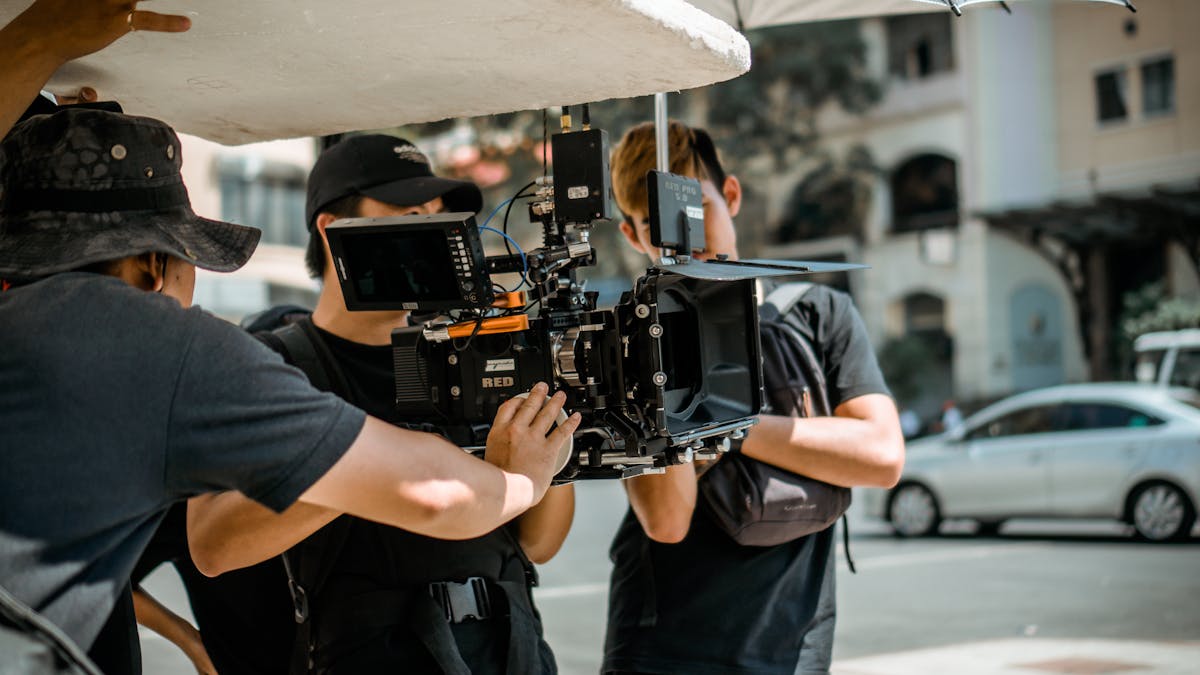 Photo by Kyle Loftus on Pexels
Behind the scenes video production documents what happens before, between, and after the shots that make the final cut — the crew briefings, camera builds, lighting adjustments, and unscripted human moments that polished brand films leave out. For brands commissioning corporate video in London, BTS content delivers higher engagement than the main production across every social platform while costing a fraction of a standalone content shoot. This guide covers the real costs of BTS video production in London, the crew and equipment you need, the permit and insurance requirements that catch out first-time commissioners, and how to brief a BTS operator so you get usable content, not raw footage.
Information Gain: Three Facts Most BTS Guides Skip
- A solo BTS operator in London costs £800–£1,200/day including a basic edit, while a BTS add-on to an existing shoot day costs just £500–£800 incremental — roughly the price of a half-day edit suite. At Airframe Media, our most common BTS engagement is the add-on: one extra camera operator joins the principal crew and captures BTS alongside the main production, eliminating separate permit, insurance, and venue-access costs. The output from one add-on day — typically 15–30 clips across formats — feeds a brand's social channels for 3–4 weeks, making it the highest-volume, lowest-cost content engine available to London marketing teams.
- The standard BTS kit for a London shoot is a Sony FX3 or A7S III body with a 24–70mm f/2.8 zoom, a DJI RS 3 gimbal, a Sennheiser MKE 600 shotgun mic, and a pair of RØDE Wireless GO II lavaliers — total kit value approximately £8,000–£12,000. This is substantially lighter than a principal production camera package (which might include an ARRI Alexa, cinema primes, and a full grip van at £50,000+). The lighter kit is intentional: smaller cameras are less intimidating, subjects forget they're being filmed, and the operator can reposition in seconds rather than minutes. Most London BTS operators own this kit outright, so there is no rental line item on the quote.
- A typical London BTS production timeline runs 7–10 working days end-to-end: 1–2 days pre-production (schedule review, shot list, permit confirmation, operator brief), 1 shoot day, and 3–5 edit days for a 60–90 second highlight reel plus a social pack of 10–15 short-form clips. Same-day social edits — 3–5 captioned vertical clips delivered by end of shoot day — are available for an additional £200–£400 and are increasingly standard for event and conference BTS where next-day posting is time-sensitive. Rush delivery of the full BTS package can compress to 5 working days if the operator has post-production availability immediately after the shoot.
What Is Behind-the-Scenes Video Production?
Behind-the-scenes video production is documentary-style filming that captures the real process, environment, and people behind a product, service, or creative project. Unlike a corporate brand film — which is scripted, lit, directed, and polished over weeks of post-production — BTS content is observational. The camera follows the action rather than directing it. The value proposition is authenticity: audiences who might scroll past a polished ad will stop to watch a lighting rig being built, a colour grade being applied, or a team huddle before a live event.
BTS video serves multiple purposes depending on who's commissioning it. Production companies and creative agencies use BTS to demonstrate scale and professionalism — a 30-second BTS reel of a 12-camera conference rig communicates capability faster than any written proposal. Corporate brands use BTS for recruitment (showing genuine workplace culture), social media engagement (process content consistently outperforms product content), and client transparency (showing the care behind a deliverable). Event organisers use BTS to capture the energy of setup and the scale of operations, which sponsors and exhibitors value as proof of delivery.
The format has grown significantly since 2023. LinkedIn's native video tools, TikTok's behind-the-scenes trend, and Instagram Reels' appetite for authentic content have all converged to make BTS one of the highest-ROI video formats a brand can commission. A single shoot day with a dedicated BTS operator can yield 15–30 usable clips across formats, enough to feed a brand's social channels for a month.
Why Brands Invest in Behind-the-Scenes Content
The engagement numbers are compelling, but the commercial case runs deeper. BTS content solves three persistent brand challenges simultaneously:
Trust and authenticity. Audiences in 2026 are sophisticated consumers of video. They recognise scripted brand content instantly and scroll past it. BTS content bypasses this filter because it doesn't look like marketing — it looks like documentation. A financial services firm showing the BTS of a compliance video shoot signals transparency. A property developer showing drone setup and site preparation demonstrates attention to detail. The implicit message is "we're confident enough to show you how we work."
Recruitment and employer brand. The London talent market for skilled roles is competitive. Candidates research companies on social media before applying, and polished "work here" videos don't convince. BTS footage of a real shoot day — the collaboration, the problem-solving, the equipment, the team dynamic — gives candidates a genuine view of workplace culture that a scripted recruitment film cannot match.
Content volume and cost efficiency. A dedicated BTS operator on an existing shoot day costs an incremental £500–£800 — roughly one-third the cost of commissioning a standalone social media content shoot. The output, however, is typically 3–5× the volume: 15–30 short-form clips from one day versus 3–5 clips from a dedicated social shoot. For brands with active social channels, BTS is the most cost-efficient content engine available.
The BTS Production Process
Pre-Production: Briefing a BTS Operator
BTS pre-production is lighter than for a principal production, but it's not zero. The operator needs:
- The principal shoot schedule. Arrival times, location addresses, key scenes, and the approximate timeline. This tells the BTS operator where to be and when.
- A shot list of must-capture moments. Examples: the creative director briefing the crew, the camera rig being built, the client arriving on set, the monitor bank during a take, the wrap and pack-down. Without a shot list, the operator may capture beautiful footage that misses the moments the client needs.
- Access and permission brief. Which areas are off-limits? Which people don't want to be filmed? Is there a confidentiality boundary (e.g. a product prototype visible in the background)? Brief the operator on restrictions before they arrive.
- Deliverable specification. How many clips? Which formats? Vertical, horizontal, or both? With captions or without? Music style? Specify these upfront so the operator shoots with the edit in mind.
On the Shoot Day
The BTS operator's job is to be present without being present. They move quietly through the set, capturing moments without interrupting the principal production. Key principles:
- Shoot first, ask later. The best BTS moments are unrepeatable — a lighting adjustment that creates a beautiful image on the monitor, a director's gesture that communicates an idea, the moment the client sees the first take and smiles. The operator needs to be continuously rolling or ready to roll.
- Capture audio as well as video. The sound of a director calling "action," the ambient noise of a set, a crew member's spontaneous comment — these are the texture that makes BTS content feel real. A BTS operator should wear headphones and monitor audio continuously.
- Shoot for the edit. If the deliverable is vertical social clips, shoot vertical. If it's a horizontal BTS reel for the homepage, shoot horizontal. The operator should know the final format before the first frame is captured.
- Stay out of the principal crew's way. The BTS operator is secondary to the main production. Never block a camera line, never walk through a shot, never distract talent during a take. A good BTS operator is invisible to the main crew.
Post-Production: Editing BTS Content
BTS editing is faster and lighter than corporate video editing. The aesthetic is documentary, not polished. Key differences:
- Faster cuts, less grading. BTS clips are typically edited with quick cuts, minimal colour grading (natural light is preferred), and simple titles or captions.
- Music selection matters. Upbeat, energetic tracks work well for BTS reels. Avoid the cinematic orchestral scores used in brand films — they create a mismatch between the authentic footage and the polished soundtrack.
- Captions are non-negotiable for social. Platforms like LinkedIn and Instagram serve most video without sound by default. BTS clips without captions lose viewers within the first 3 seconds.
A typical BTS post-production timeline: 1–2 edit days for a full-day shoot, producing a 60–90 second highlight reel plus 10–15 short-form social clips. Same-day social edits are possible — a BTS operator can deliver 3–5 captioned vertical clips by end of shoot day for next-day posting.
London-Specific BTS Considerations
Filming BTS content in London involves the same regulatory landscape as principal production. This catches out brands that treat BTS as informal or secondary — London boroughs and private estates do not distinguish between a £50,000 brand film and a single-operator BTS shoot. Both require permits, insurance, and permission.
Permit lead times. City of London: 10 working days minimum. Westminster: 7 working days. Tower Hamlets (Canary Wharf): 5 working days plus direct estate liaison. South Bank and Royal Parks: variable, contact the relevant authority directly. Do not assume BTS is exempt — borough enforcement officers will shut down unpermitted filming regardless of crew size.
Insurance requirements. Most London corporate buildings require £5 million public liability as a minimum. Hotels, financial-district offices, and event venues typically require £10 million. The commissioning business should confirm the BTS operator's PLI certificate names the venue as an additional interest where required. For a full breakdown of production costs including insurance, see our guide to London video production costs and budgets.
Venue relationship management. If the principal production has already negotiated filming permission with a venue, confirm in writing that BTS is included in that permission. Some venues restrict BTS specifically — they want the main production documented but not their facility, staff, or back-of-house operations. Clarify before shoot day.
ULEZ and congestion. Most of central London is within the Ultra Low Emission Zone. BTS operators driving to multiple locations in a single day need to account for ULEZ charges (£12.50/day for non-compliant vehicles) and congestion charging (£15/day). These are line-item costs that should appear in the BTS quote.
Equipment and Crew for BTS
BTS equipment is chosen for mobility and discretion, not absolute image quality. The key trade-off: a cinema rig on a tripod gets beautiful footage but changes the behaviour of everyone on set. A compact mirrorless camera on a gimbal captures less pristine footage but documents genuine behaviour because people forget the camera is there.
Standard BTS kit: mirrorless camera body (Sony FX3, A7S III, or Canon R5), 24–70mm f/2.8 zoom lens (covers wide establishing shots and close-up detail without lens changes), shotgun mic for ambient audio, lavalier mic for interviews, small LED panel for sit-down interview lighting, gimbal for movement shots.
Crew:
- Solo BTS operator (£800–£1,200/day): one person handling camera and audio. Best for social-first BTS on a contained shoot.
- Two-person BTS crew (£1,800–£2,800/day): camera operator plus producer who handles interviews, coordinates with the main crew, and manages the deliverable list. Best for corporate BTS where client interviews and stakeholder coordination are required.
- BTS add-on to principal crew (£500–£800/day incremental): the most cost-efficient option. One additional camera operator joins the existing shoot day. The principal crew already has insurance, permits, and venue access — the BTS operator simply rides on that infrastructure.
For productions requiring a full crew with specialist operators, see our guide to hiring a London-based video crew.
BTS for Different Industries
Corporate and financial services. BTS for banks, asset managers, and fintech firms needs particular care. Compliance departments often restrict filming of computer screens, open documents, and client-facing areas. Brief the compliance team before the shoot and agree on a filming perimeter. The BTS operator needs to know exactly which angles are approved and which are not.
Events and conferences. BTS at live events is high-pressure: the operator has one chance to capture setup, registration, speaker prep, and crowd energy before doors open. A pre-event walkthrough with the event producer identifies the key moments and the shooting positions that won't obstruct attendees. Multi-camera events at venues like ExCeL London require the BTS operator to coordinate with the principal camera crew to avoid crossing sightlines.
Property and construction. BTS on construction sites requires PPE (hard hat, hi-vis, steel-toe boots), a site induction, and permission from the site manager. Drone BTS of a construction project adds CAA operational authorisation requirements. The operator needs to be briefed on exclusion zones and active work areas.
Creative agencies and production companies. BTS for agency portfolio use is the most permissive category — the set is the agency's own work, so there are fewer confidentiality concerns. The priority is capturing scale: wide shots of the set, close-ups of camera monitors showing the live image, crew interaction, and client reactions. This footage is used in pitch decks, website portfolios, and social media to demonstrate production capability to prospective clients. For examples of how London agencies structure their portfolios, explore our London corporate video production services.
How Much Does BTS Video Production Cost in London?
BTS video production costs vary by crew size, shoot duration, and the complexity of the deliverable package.
| Engagement | Cost | Best for |
|---|---|---|
| Solo BTS operator, half-day | £600–£900 | Short social capture, single-location |
| Solo BTS operator, full day with edit | £1,200–£2,200 | Shoot day documentation, social pack (10–15 clips) |
| Two-person BTS crew, full day with edit | £2,200–£3,800 | Corporate BTS with interviews, multi-location |
| BTS add-on to existing shoot day | £500–£800 | Most cost-efficient; one extra operator on set |
| BTS social pack (edit only) | £400–£700 | 5–8 vertical clips with captions and music |
The most common engagement is the BTS add-on: a dedicated operator joins an existing shoot day for £500–£800, capturing BTS alongside the principal production. This eliminates the fixed costs of separate insurance, permits, and venue access while producing enough content for a month of social posting.
Post-production for BTS runs lighter than the standard 3:1 post-to-shoot ratio used for corporate video. A full-day BTS shoot typically requires 1–2 edit days, producing a 60–90 second highlight reel plus 10–15 short-form social clips. Same-day social edits — 3–5 captioned vertical clips delivered by end of shoot day — are available from most London BTS operators for an additional £200–£400.
Frequently Asked Questions
What happens during a behind-the-scenes video shoot?
A behind-the-scenes video shoot runs parallel to the principal production. The BTS operator arrives with the main crew — typically 30 minutes before call time — and begins capturing the setup: camera rigs being built, lighting being positioned, the director reviewing the shot list, and the empty set before talent arrives. Throughout the shoot day, the operator moves quietly through the set capturing crew interactions, creative decisions at the monitor bank, client reactions during takes, and the problem-solving moments that define professional production — a lighting adjustment that transforms a flat scene, a lens change that solves a framing issue, the sound recordist repositioning a mic to eliminate background noise. Between setups, the operator captures the environment: the location, the equipment, the scale of the operation. At wrap, they capture pack-down and the crew's post-shoot debrief. The operator shoots continuously because the best BTS moments — a spontaneous crew laugh, a director's gesture that communicates an idea instantly, a client's genuine reaction to seeing their first take — are unrepeatable. By end of day, a single operator will have captured 2–4 hours of source footage across wide, medium, and close-up coverage, from which the editor extracts 15–30 usable clips. The key difference from principal production: the BTS operator does not direct, does not adjust lighting for aesthetic effect, and does not ask subjects to repeat actions for the camera. Authenticity depends on being unobtrusive.
How much does behind the scenes video production cost in London?
A standalone BTS video production in London costs £1,200–£3,800 depending on crew size and deliverables. A solo BTS operator for a full shoot day with a 60–90 second highlight reel and a social pack of 10–15 short clips runs £1,200–£2,200. A two-person BTS crew — camera operator plus producer for interviews and coordination — costs £2,200–£3,800 for the same deliverables. The most cost-efficient option is the BTS add-on: an extra operator joins an existing shoot day for £500–£800, capturing BTS alongside the principal production. This eliminates separate insurance, permit, and venue-access costs because the principal production already covers them. Post-production for BTS is lighter than corporate video — budget 1–2 edit days at £400–£600/day for a full-day shoot's output rather than the standard 3:1 post-to-shoot ratio. Same-day social edits (3–5 captioned vertical clips delivered by end of shoot day) add £200–£400. The total investment for a BTS add-on with full social pack typically lands between £900 and £1,400 all-in — roughly one-third the cost of a standalone social content shoot producing one-fifth the volume of usable content.
What equipment is used for behind the scenes filming?
BTS equipment is chosen for mobility and discretion rather than absolute image quality. The standard London BTS kit centres on a mirrorless camera body — Sony FX3, A7S III, or Canon R5 — paired with a 24–70mm f/2.8 zoom lens that covers wide establishing shots and close-up detail without lens changes that slow the operator down. Audio is captured via a Sennheiser MKE 600 shotgun mic for ambient sound and a pair of RØDE Wireless GO II lavaliers for sit-down interviews or presenter-led segments. A DJI RS 3 or RS 4 gimbal stabilises movement shots through crowds or across locations. Lighting is typically natural or available-light only; a single Aputure Amaran 60d or similar LED panel is carried for interview lighting when the available light is insufficient. The total kit value is approximately £8,000–£12,000 — substantially less than a principal production camera package — and most London BTS operators own this kit outright, so no rental line item appears on the quote. The intentional lightness of the kit serves a creative purpose: smaller, quieter cameras make subjects forget they are being filmed, producing more authentic footage. A cinema rig on a tripod gets technically superior images but changes behaviour — people perform differently when a "real" camera is on them.
How long does a BTS video shoot take?
A standalone BTS video production follows a compressed timeline of 7–10 working days end-to-end from brief to final delivery. Pre-production takes 1–2 days: reviewing the principal shoot schedule, identifying the key capture moments, confirming permits and insurance, and briefing the BTS operator on access restrictions and deliverable formats. The shoot itself runs 1 day (or mirrors the principal production's duration — 2–3 days for multi-day shoots). Post-production takes 3–5 edit days: the editor assembles a 60–90 second highlight reel plus 10–15 short-form social clips from the day's footage. When BTS is an add-on to an existing production, the total timeline compresses: the shoot day is already happening, so the only incremental time is the edit, which completes within 1 week of the principal edit. Same-day social edits — 3–5 captioned vertical clips delivered by end of shoot day — are available for an additional £200–£400. Rush delivery of the complete BTS package (highlight reel plus social pack) can compress to 5 working days from the shoot date if the operator has immediate post-production availability.
Can behind the scenes footage be used for social media?
Yes — BTS content is among the highest-performing formats on social media, and most BTS commissions are specifically for social use. LinkedIn data shows that behind-the-scenes content generates 2–3× higher engagement than polished corporate posts, with completion rates approximately 40% above brand films (LinkedIn B2B Content Benchmark 2025). For Instagram and TikTok, BTS clips formatted vertically (9:16) with captions and trending audio consistently outperform scripted brand content in views, likes, shares, and saves. The format works because audiences trust process over polish — a 15-second clip of a lighting setup, a colour-grading session, or a team briefing before a live event gets more engagement than a polished final cut of the same project. Practical delivery: when commissioning BTS, specify vertical capture as a deliverable alongside horizontal master footage. Most London BTS operators now offer a BTS social pack — 5–8 vertical clips with captions, music, and platform-optimised durations — as standard output rather than an upsell. The client receives ready-to-publish files designed for immediate posting to LinkedIn, Instagram Reels, TikTok, and YouTube Shorts, not raw footage requiring in-house editing resources.
Working with Airframe Media
Airframe Media has been producing behind-the-scenes content alongside corporate, event, and brand-film productions in London since 2015. Our BTS operators are experienced at working alongside principal crews without disrupting the main production — they know where to stand, when to move, and how to capture the moments that matter without getting in the way.
Every BTS engagement includes a pre-shoot brief (we review your shoot schedule and identify the must-capture moments), on-the-day capture by an operator who understands both cinematography and documentary storytelling, and post-production tailored to your platforms — horizontal reels, vertical social clips, captioned versions, and same-day edits where required. Our most common BTS engagement is the add-on to an existing production: one extra camera operator joins your shoot day for £500–£800, capturing BTS alongside the main production. The output — typically 15–30 clips in horizontal and vertical formats — is delivered within 1 week of the shoot.
If you're commissioning a corporate video and want to add BTS capture to the same shoot day, mention it at the quoting stage — the incremental cost of a BTS operator is substantially lower than commissioning a separate shoot, and the content volume feeds your social channels for weeks.
Ready to document your next production? Get in touch to discuss BTS video production for your London project, or browse our portfolio to see examples of our corporate and event production work.
For more on production planning and costs, read our guides on London video production costs, hiring a London video crew, and our London corporate video production services.
ABOUT THE AUTHOR
Founder & CEO
Liam founded Airframe Media in 2015 and leads creative direction across the studio. He has produced 500+ corporate, commercial, and event films for UK businesses including Levy, Taylor Wimpey, and ExCeL London, and writes about the craft of professional video production in London.
TAGS
Related Services
Ready to Bring Your Vision to Life?
Let's discuss how our video production services can elevate your brand


